How to Give Your Customers Value from Your Eblasts
Getting prospects and customers to open your email marketing is becoming increasingly challenging. Between busy schedules, spam filters, and AI assistants, there are plenty of ways your email can end up the wrong place if people don’t understand why you’re emailing them or, most importantly, why they should bother to open your email.
If your customers love you, it won’t be an issue, but if you are emailing someone who is just getting to know you, it’s a different story. In that case, there is only one reason for them to open your email:
To get something they want.
And what do people want from email marketers? Many things, but all can be summed up in one word:
Value.
What is Value?
 Value can be defined different ways, depending on who you ask, however it is always something desirable. Forrester defines four dimensions of customer value:
- Economic (money gained, not wasted)
- Functional (easily completed)
- Experiential (pleasant interaction/sensation),and
- Symbolic (feeding status, self-worth, and belonging)
All four dimensions are desired, in fact, irresistible, to prospects and current customers. Marketers who can strategically try to hit all dimensions of customer value within their email marketing will hit the jackpot.
From the email subject line to the Call to Action, the email should be created through the hungry, discerning eyes of a prospective customer looking to see what’s in it for them. Too many email campaigns focus on promoting their business rather than rewarding the customer with some value for opening their email. Do this too often and your unopened and unsubscribes will soar.
On the other hand, if you infuse value into every email, your audience will stay steady or grow through organic sharing of your emails. If you’re wondering if your emails are providing value, ask yourself if they contain any of the elements of value. These include:
- Content that intrigues or fascinates the recipient
- Content of relevance that informs the recipient about current trends, culture, etc.
- Content of monetary value, that provides a discount or bonus for the recipient
- Content of reference that provides a keepsake for the recipient
- Content of exclusivity, that imparts something selective to the recipient and others
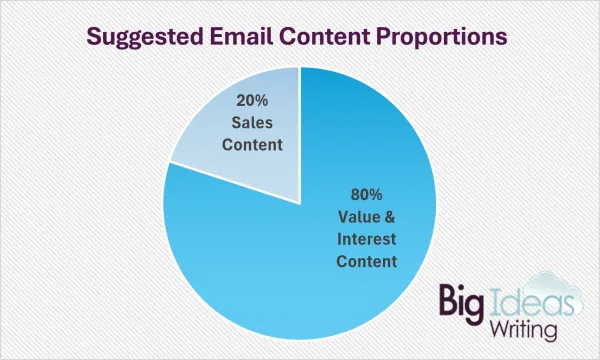
It’s easy to turn to email marketing when you are selling and have a special promotion, new product or upcoming event. There’s nothing wrong with sending such emails. But the best way to ensure you’re sending valuable email marketing content is to apply the famous 80/20 Pareto Principle to your marketing. It works for social media as well. Simply stated, it encourages that only 20 percent of your email content should be promotional. The majority (80 percent) should of true value to the audience. In other words, you can sell, but most of your communication should focus on helping, informing, or engaging your audience.
Now, let’s dig a little deeper into these concepts and see what you can do as an email marketer to infuse something of value into each of your emails so both you and the recipient win.
1. Share Helpful Tips and Expertise.
 Your customers chose your business because of your expertise. Use your emails to share practical advice that helps them solve problems.
For example, Pro-Home Services, a roofing contractor, typically shares a blog with advice on selecting products or planning for home improvement in their emails, as well as providing a special discount or offer on products and services. A financial advisor could explain common retirement planning mistakes or changes in tax law. A retailer might offer guidance on choosing the right product for specific needs.
When subscribers learn something useful, they begin to view your emails as a resource rather than an advertisement. Here are some fun (and easy!) ways to do this.
- Share a link to an online blog you’ve written about your products or services
- Summarize an industry report and provide a link to it
- Interview the CEO or someone of interest and share it in the email
- Give a “top 10” list or “do’s and don’ts” on a relevant subject
- Produce and share a helpful guide to something pertinent to your business
- Include a coupon or discount with the email
- Use attractive imagery they will look forward to
- Tell a story about a satisfied customer in a problem/solution/result format
2. Help Customers Save Time.
Everyone is pressed for time these days. If you can turn your email into a timesaver, people will never fail to open and consume it. Here are some ways to do it.
- Share industry trends as reported by experts
- Create and share a calendar of Important industry or related deadlines
- Summarize new regulations and provide next steps for compliance
- Curate and share a list of helpful tools and resources
- Provide a calendar of relevant local, national, or industry events
By doing the research for your audience, you save them time. Be sure to include your logo on anything downloadable that they may print out and keep at their desk.
3. Inspire and Entertain.
 Not every email needs to be educational. Sometimes the greatest value comes from making someone’s day a little brighter, or letting your customers and prospects get to know you a little bit better.
Consider sharing:
- Customer success stories and testimonials
- Behind-the-scenes glimpses of your business
- Holiday greetings and related information
- Employee spotlights
- Industry anecdotes
- Your Employee’s Top 10 __________
- Funny uses or outcomes from your products and services
- Brain teaser or puzzles. Include the answers in the next email.
- Opportunities to enter raffles, contests, etc. with winners announced in the next email
By entertaining people in your emails, you will encourage them to interact with you and your brand. People connect with people, so authentic stories will help build bonds that strengthen your relationship beyond the transactional.
4. Answer Frequently Asked Questions.
If one customer has a question about something, chances are there are many more who have the same question. Answering these questions provides a direct value to recipients of your emails and provides an opportunity for valuable content.
Create emails that address:
- Common misconceptions
- Product usage tips
- Service processes
- Buying considerations
- Troubleshooting advice
These emails provide immediate value while also reducing customer confusion.
5. Offer Exclusive Benefits.
Have you ever been invited into an exclusive club? Undoubtedly, it made you feel special, and your emails can create that same sense of belonging for customers. Define what makes your “secret club” valuable, then invite subscribers in by sharing exclusive benefits or offers.
The exclusive benefits will vary, depending on your industry, product or service. Some that you can consider providing include:
- Early access to sales
- Exclusive content
- Downloadable guides
- Bonus resources
- Special invitations
- Subscriber-only discounts
When customers feel they’re receiving something special, they have a stronger reason to remain subscribed.
6. Write Subject Lines That Promise Value.
Even the most helpful content won’t matter if subscribers never open the email.
Strong subject lines clearly communicate the benefit of opening.
Instead of:
- “June Newsletter”
- “Company Updates”
- “Our Latest Promotion”
Try:
- “5 Ways to Reduce Energy Costs This Summer”
- “The One Mistake Most Homeowners Make After a Storm”
- “What Every Business Owner Should Know About Cybersecurity”
The best subject lines answer the reader’s unspoken question: “Why should I open this?”
7. Use Video.
Marketing experts agree, and their email open rates prove it: people love video. industry research consistently shows that video increases engagement. Studies have found that simply including the word video in an email subject line can increase open rates by 19%, while emails featuring video have been shown to generate substantially higher click-through rates than text-only emails.
Video entertains and is low-effort for the recipient. Like a blog that can be read aloud, a video can be a companion for multi-tasking, and therefore is a popular medium for many people. So, since any idea to include within an email can be presented in a number of different ways, it’s worth consider utilizing the animated, life-like medium of video to express your message.
7. Measure What Resonates.
Pay attention to which emails generate the highest open rates and click rates.
You may discover that:
- Educational content outperforms promotions.
- Customer stories drive more engagement than company news.
- Checklists and how-to guides receive the most clicks.
Let your audience tell you what they value most, then create more of it.
The Bottom Line
Successful email marketing isn’t about sending more emails. It’s about sending more valuable emails.
Every message should answer one question: “How does this help my customer?”
When subscribers consistently receive useful information, practical advice, inspiration, or exclusive benefits, they begin to trust your brand. That trust leads to higher open rates, stronger engagement, and ultimately more business.
The businesses that win in email marketing aren’t necessarily the ones that send the most messages. They’re the ones that provide the most value.